雪板
不同雪板适用于不同的滑雪类型。要了解背后的原因,我们首先要了解雪板是如何工作的。一块滑雪板的背后可能比你想象的要多,而且一些你没有注意到的事情会对滑雪板的性能产生很大的影响。
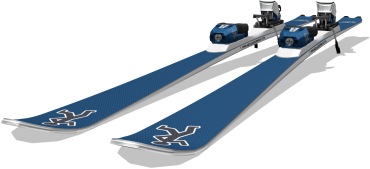
接下来的部分解释了雪板的每个部分和属性的作用,以及所有这些是如何结合起来的,以使雪板适应不同类型或风格的滑雪运动。
板底
板底是指滑雪板底部与雪地接触的区域。一般来说,在购买滑雪板时,大家不会太多关注于板底,尽管它依旧是滑雪板非常重要的组成部分。
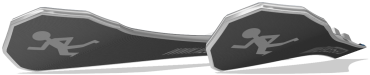
为了使雪板在雪地上滑行并保持良好的状态,需要在滑雪板上涂抹一种特殊的蜡。通常情况下,我们用热的打蜡器将蜡融化在板底上(尽管有一些效果较差的蜡可以在冷的情况下使用)。良好的上蜡是保持雪板板底快速和完好最重要的事情。不同类型的蜡通常适用于不同温度的雪,有些蜡中还含有不同的添加剂。这些都在雪板结构页面上有更详细的介绍。
雪板板底由 P-Tex(一种聚乙烯塑料)制成许多不同的形式。P-Tex 有不同的质量,有挤压和融塑的结构,还有不同的添加剂可以使用。这使得不同类型的板底具有不同的特点,这可以使它们更快、更强或容纳更多的蜡。不同类型的板底和它们的特性在雪板结构章节中有更详细的介绍。简而言之,融塑式板底比挤压式板底要好,因为它们更耐用,速度更快,保蜡效果更好,但同时也会更昂贵,更难维修。最好的板底类型是融塑的混合体,其中包含石墨和其他材料,它们的持蜡量更好,速度也更快。它们总是深黑色的,最常出现在比赛雪板上。
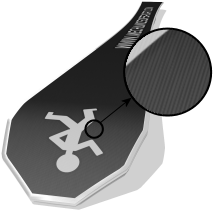
如果雪板压过石头等硬物,底部可能会被划伤。对于一般的滑雪运动,只要滑雪板保持良好的打蜡状态,底部的划痕数量不会有太大的影响。不过如果有大的划痕,最好是沿着滑雪板的长度方向且不要太靠近板刃。
当滑雪板已被使用一段时间并在板底上有一些划痕时,作为滑雪服务的一部分,通常需要对雪板板底在机器上进行打磨,在板底和底刃磨掉一层,使板底和板刃重新变得光滑。板底被打磨后会留下沿滑雪板长度方向的轻微凹槽。根据这些凹槽的深度和间距,它使滑雪板更适合不同的雪况。一般来说,沟槽越深,间隔越远,在较湿的雪地上就越好。然而,大多数滑雪者不会考虑这些情况使用他们的雪板,并且不了解这些基础结构所能带来的差异。
板刃
板刃是指沿着滑雪板两侧的金属条。板刃非常重要,会滑雪板的性能产生很大的影响。有许多东西会影响板刃和它们的工作方式,如侧切半径、边缘角度、锋利度和硬度(硬度将在它自己的章节中解释)。我们首先看一下侧切半径。
侧切半径
If you look at a ski you will see that it is wider at the tip and tail than it is in the middle. This is because the edges have been shaped so that they curve along the sides of the ski. If the ski is tilted onto an edge, this curve will try and lead the ski around in a circular path. The curve shape on the edge of the ski is called the sidecut, and will have a sidecut radius which is determined by the effective radius that the curve has. The radius of the sidecut (or R) is normally written on the top of the ski somewhere with a measurement in metres. A ski with a smaller sidecut radius will make smaller tighter turns when the ski is being carved, whereas a ski with a larger sidecut radius will make larger turns. The radii on skis can vary largely, and are normally suited to the style of ski. The sidecut radius is not the radius that a turn will be when the ski is carved however, and is in fact closer to being the maximum radius a carved turn can be. The more a ski is leant over the smaller the radius of the edge touching the snow will become, and generally speaking the smaller a carve turn will become.
The edge is shaped as part of a circle with radius R A rough guide to sidecut radius and types of ski is given below:
| Radius (R) | Type of Ski | Description |
|---|---|---|
| 10m - 12m | Slalom | These skis will make small aggressive turns when carved, intended for small slalom race turns. |
| 14m - 20m | Allround, Freestyle, Beginner, Powder | Most types of ski generally have radii within this range. These skis are generally a bit more stable at higher speeds than slalom skis, and are well suited to general piste skiing at the speeds that most people ski at. |
| 20m - 30m | Giant Slalom, Freestyle,Powder | Giant slalom skis make larger turns when carved, and need to be used at higher speeds to work properly. They are intended for larger giant slalom turns, at speeds towards the top end of what people generally ski at on an open piste. Freestyle and powder skis can also have radii within this range as they are not used to carve aggressively, and are not intended to be skied with the same speed and aggression as giant slalom skis. |
| 30m + | Super-G, Downhill | These skis are only really used by racers as the speeds needed to use them properly are too fast and dangerous for most pistes. |
Over the past few years some manufacturers have been making skis where the sidecut radius changes along the ski. This concept enables the skier to use one sidecut radius when they lean further forwards, and a different sidecut radius when their weight is a bit further back on the skis. Although many skiers are not convinced by the practicality and results from this approach, the technology has proved popular enough to make its way permanently into some manufacturer's product lines.
Sharpness
How sharp the edges on a ski are makes a big difference to how well the ski will cut into the snow. Edges that are sharp and smooth will have less resistance and cut into the snow better than edges that aren't, giving you more edge control.
Edge Angles
The angle that the edges are sharpened at also makes a large difference. Most types of ski are used with side edge angles of between 90 and 88 degrees, with racing style skis generally having an edge angle of 87 degrees. Skis used for competitive racing however can have edge angles lower than this. As the diagram shows there is not much of a difference between these angles, especially when you consider that an edge is only a few millimetres thick, yet these small differences in angle can have a very noticable effect. Lower edge angles will not work on all skis though. Apart from the increased skill needed to use smaller angles, a ski needs to be very stiff to handle a very sharp edge, or the ski will just bounce around on the snow with the edge catching and releasing, giving less control than if the edges weren't as sharp.
The side is not the only angle of the edge that can be changed though, there is also the angle of the edge on the bottom of the ski. This is not as commonly changed or set as side edge angles, but a lot of people swear by base edge angles, as they can also change the characteristics of a ski, including making it harder for edges to snag in the snow when you don't want them to. When base edge angles are set it is normally between 0.5 and 3 degrees.
Stiffness
Generally the stiffer a ski is the more responsive it will be, the better it will be able to hold an edge in hard packed snow, and the better the handling will be at higher speeds. This all sounds very good, but also the stiffer a ski is the less forgiving it will be if you make any mistakes, and many people don't want a ski that responds to even the smallest inputs.
So although a stiff ski can let you push and carve harder than you had ever imagined, it can also throw you to the ground before you realise you did anything wrong. Therefore you need to match the stiffness of a ski to your abilities, and the kinds of skiing you want to do.
To explain why stiffness makes these differences, as a ski travels along it will hit lots of small bumps and gradient changes in the snow. If a ski is really flexible these bumps will make the tip and tail of the ski bounce out of the snow, momentarily releasing the edges along those areas, which at high speeds can even make the whole ski shake. With a stiff ski, the stiffness pushes the tips into the snow harder, so that the tip and tail bounce out of the snow less, and when they do lose contact with the snow the tip and tail are pushed back into the snow sooner and harder. Therefore a stiffer ski gives you better edge control, and overall handling at higher speeds. The problem is if you get into trouble and need to release the edges to recover, they won’t release so easily with a stiffer ski and could mean that you won't manage to recover. Freestyle skis are generally quite soft as they need to be fairly forgiving to get you out of trouble on those dodgy landings, and the flex makes tricks easier to do. Whereas racing skis are stiff as they are intended for higher speeds, and maximum edge grip and responsiveness. Generally beginners use more flexible skis, as they are not ready for the responsiveness of stiffer skis, and they want to be able to get away with making mistakes. The average skier will have a ski with a medium stiffness, as they want a ski which they can have fun on, but that is still comfortable to use and easier to control.
Torsional stiffness is also very important for skis as if a ski will twist the edges will not push on the snow with as much force. This effects a ski in very similar ways to stiffness along the ski with torsionally stiffer skis being less forgiving and intended more for racing.
Skis are generally a bit more flexible towards their tips than their tails, this enables the skis to bend better when going over bumps or through gradient changes.
Some of the newer skis now coming out have devices in their riser plates that can change the stiffness of the ski, meaning that the stiffness of the ski can be adjusted to suit the terrain you are skiing at the time. Time will tell how effective these adjustment mechanisms are and how popular they become.
Camber
Camber is the shape a ski has vertically along its length. Most skis are arched so that the area under the binding is above the snow when there is no weight on the ski, with the areas at the ends of the sidecut touching the snow just before the tips start. This shape means that once weight is put on the ski, the flex of the ski will always try to push the whole length of the ski into the snow, which gives you more control from the edges. The amount of camber a ski has is measured by the height the middle of the ski sits above a flat surface when there is no weight put on it.
A well as edge grip, a ski's camber can effect how lively a ski feels to use, although stiffness also plays a large part here. The camber shape is what keeps the length of the ski pushing into the snow, but it is the stiffness that determines how hard the ski pushes. So although although camber is measured by the height the middle of the ski sits at, the liveliness and edge hold it creates is also very dependent on stiffness.
Many newer powder and freestyle skis are coming out with negative cambered areas (rocker shapes), or other shape variations. This goes against traditional ski design, but it does let the skis float better in powder and turn more easily in the snow park. These new camber types are gaining popularity very quickly, the different shapes that are being used are covered in the Ski Cambers page.
Width
The width of a ski can make a difference to how well the ski floats in powder, and to how much pressure can be applied to the edges. If a ski is very wide, it will increase the surface area of the base, which in turn puts less pressure into the snow underneath and makes the ski float better in powder. Which is why powder skis are often very wide. However the width of a ski also effects how easy it is to apply pressure to the edges, with it being harder to create edge pressure the wider a ski is. Therefore racing skis and skis intended for icy conditions where edge pressure is very important are normally narrower. The current trend is for manufacturers to make allround skis a bit wider so that they are better in powder, but not so wide that there is any major effect on their icy handling abilities. A ski's width is normally given in three measurements, tip width, waist width, and tail width, which are normally written somewhere on the top of the ski.
Length
The length of a ski makes many differences too. Longer skis generally have more control at high speeds, and more edge grip, but are harder to turn as they have more rotational inertia. The length of a ski also makes a difference in powder, as increasing the length increases the base area, which make a ski float better in powder. Therefore the length of a ski needs to be matched to how fast a skier wants to go, how quickly or often they want to turn, and how much powder they want to ski, as well as have their height and weight taken into account, with taller and heavier people needing longer skis.
Weight
Heavier skis are harder to throw around, but do stick to the snow better and bounce around less, giving more control over the edges. This is why most racing skis are quite heavy. Beginners skis tend to be lighter as they need to be moved around easily, the same as freestyle skis, as they need to be able to spin with as little effort as possible. Most skis though fall into the allround category and are not too light but not too heavy either.
Riser Plates / Race Plates
Riser plates are plates that are mounted to skis where the bindings sit. They make the binding sit higher above the ski, which in turn increases the distance of a ski boot away from the ski. A lot of skis, if not most skis, do not have riser plates, however most race skis and many piste orientated skis do have riser plates on them. Riser plates enable more pressure to be put on the edges and make ski boots drag in the snow less on leant over turns. Hence why it is common for skis that are intended to be used in icy conditions where edge pressure is important, to have riser plates fitted to them.
Ski Tips
On all skis the front tip curves upwards so that the ski can go over bumps, and handle changes in gradient. Most skis have a large tip at the front, and a small tip at the back, however freestyle skis and many powder skis, are also designed to be skied backwards, and because of this also have large tips at the back. The tips start at the end of the sidecut on a ski, as from this area on the edge is not used to turn.
On some racing skis the tips differ to most skis, some slalom skis have a-symmetrically shaped tips so that if the ski goes straight into the pole at a gate there is a higher chance that the pole will be deflected around the outside of the ski. Some other racing skis have holes in the tips, which decreases the weight of the ski at the very ends making the ski slightly easier to turn, and which also let air through, marginally decreasing the skiers air resistance. Generally speaking ski tips are not something to worry about, although having slightly longer wider ski tips will help a ski to float in powder.
Tip Protectors
Often skis have plastic on the end of the tail to protect both the floor and the skis when they are left leaning against a wall. Many skis also have protectors on their tips, this helps protect both the skis and windows in gondolas or anything else that might get scratches by an exposed metal edge.
Ski Dimensions
The diagram below shows the commonly used dimensions of a ski.
Types of Ski
Here are a few styles of ski with descriptions of how their dimensions and properties give them their characteristics.
Allround Skis
Allround skis are the most common type of ski, and are intended to be reasonably good for most types of skiing. They generally have a radius of about 16 to 20m, with a medium stiffness, medium width, and even a medium length compared to other styles of ski. This type of ski is very good for the average skier, as they are as good at each style of skiing as the average skier is capable of skiing the styles. Allround skis do not excel at any style of skiing, but if you need one pair of skis that are capable of having a fair go at anything, this is generally the type of ski you will end up with.
Beginner Skis
Beginner skis are normally shorter, lighter, and more flexible. Being short and light makes them easy to move around, while the flexibility enables beginners to recover from mistakes more easily. The sidecut radius can vary but it is normally about 16m or so. The edges on these skis are also not too sharp as they don’t need or want to dig into the snow too aggressively.
Slalom Race Skis
Slalom race skis are short, stiff, heavy, and have a radius of about 12m. The shortness makes them easier to turn quickly, while the stiffness and weight let them cut into the snow aggressively. They are intended for slalom racing.
Freestyle Skis
Freestyle skis are intended to be used in the snow park, where they are used for jumps with spins, grinding rails and boxes, and hitting any other obstacles that can be found. They are normally twintips (have large tips on both ends) so that they can be skied backwards almost as well as forwards. They are usually quite light and short so that they are easy to spin and turn, and are flexible so that they are forgiving on landings and when mistakes are made. The radius is generally about 18m. Many modern freestyle skis are also incorporating rocker cambers into their design.
Powder Skis
Powder skis are designed for off-piste skiing, and are normally wide and long so that they have a large base area, enabling them float above soft snow better. They normally have a large radius although it is not really used in the powder, and are generally quite flexible to allow the ski to bend and make shorter turns, although the flex can vary quite a lot between skis. Many modern powder skis use rocker cambers, to let the ski float even better in powder. There are many different types of rocker camber that they can have though, and the camber shape will depend on what the ski is intended for.
Giant Slalom Skis
Giant slalom skis are racing skis intended for giant slalom racing. They are stiff, heavy, fairly long, and normally have a radius of 20 to 30m. This results in a ski that is very aggressive, and is intended for speeds towards the top end of what is normally possible on a piste, due to the visibility and room available. Most people who have this type of ski are fairly serious, and well trained skiers.
Downhill Skis
Downhill skis are for racing on world cup downhill courses, and are only intended for racing. Downhill skis are very long (typically over 2m), stiff, heavy, and have a very large sidecut radius. They are designed for very large turns at very high speeds, on very icy snow. You can not really buy downhill skis in shops as they are for racers only, and due to the high speeds need a cleared and carefully prepared piste to be used.
The information here is for alpine skiing, there are other not so common types of skiing as well, including telemarking, and crosscountry skiing. In the future small sections on other types of skiing will be included on the site, so that people can familiarise themselves with them as well.
Move on the the Ski Construction page, or onto the Ski Bindings section.